vendredi 30 janvier 2009

SOMMES-NOUS DANS LA BRUME? – La photo a-t-elle remplacé la mémoire?

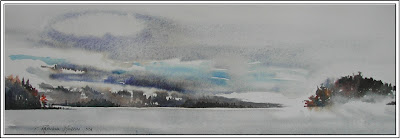
"Brouillard sur Lac Tremblant Nord, sapin orangé"

« Qu’est-ce qui tenait lieu de la photographie avant l’invention de l’appareil photo? On s’attend à ce que la réponse soit la gravure, le dessin, la peinture. Une réponse plus révélatrice pourrait être : la mémoire. Ce que font les photographies était auparavant fait à l’intérieure de la réflexion. » John Berger dans Uses of Photography.*


"Morning Fog and Reflection, LTN"


Le matin, j’aime m’installer au bord d’un lac afin d’observer et peindre l’effet du brouillard. Je me lève très tôt afin de me préparer avec pinceau, pigments et papier prêt à capter l’effet atmosphérique qui sera de courte durée.

Par un matin brumeux, mon amie a documenté en photo non seulement le levé de soleil mais aussi quelques étapes de ma peinture en évolution. Comparez les photos de la scène avec celle peinte. La photo capte un très court moment. Moi, je fais une synthèse d’un phénomène atmosphérique. Voilà, je crois, la différence entre une œuvre artistique et la photo statique.

"Golden Fog Lifting, Lac Tremblant Nord"

Il faut une mémoire pour créer –tel que le suggère l’écrivain et critique d’art, John Berger. L’appareil photo ne possède pas le même type de mémoire que l’humain. La caméra n’enregistre qu’une fraction de seconde. Pendant les quelques vingt minutes que je peins le brouillard je réfléchis et j’interprète. Je développe mon aquarelle à l’aide de la même matière qui se transforme devant moi, de l’eau. C’est le médium idéal selon moi pour peindre ce sujet. Et, avec émotion et sentiments face à ce phénomène en mouvement, je place au fur et à mesure de la couleur sur le papier.
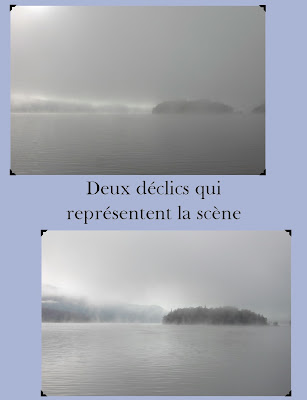

Je ne crois pas que je pourrais faire le même exercice en studio à partir de la photographie de la scène. Vaudrait mieux tenter de peindre la scène de mémoire sans aucune référence photo.


Les étapes :

1. Je mouille la partie supérieure de la feuille à partir de l’horizon jusqu’en haut. Donc, je travaille d’abord mouillé dans mouillé ciel et terre.


2. Lorsque j’ai peint une grande partie du ciel et la brume qui se diffuse sur les îles je laisse les pigments s’entremêler. Puis, je commence à peindre la section du bas, le lac. Je travaille cette partie plutôt mouillé sur sec. Il est impératif de réserver du papier non peint entre lac et terre. Autrement les couleurs des deux parties se fusionneront et je ne pourrai pas rendre l’effet blanc et lumineux entre lac et montagne.


3. Je peins des traits parfois minces parfois plus larges. Ceux-ci représentent couleur et valeur du mouvement des vagues. Entre ces lisières humides et teintées, je réserve le papier sec afin de distinguer eau colorée et reflet blanc.


4. Au fur et à mesure que le pigment s’imbibe dans le papier à l’étape du mi-humide je dépose de l’eau claire entre ces bandes de couleur afin qu’elles s’entremêlent partiellement les unes dans les autres. Finalement, il faut savoir quand s’arrêter. Si je reviens au mauvais moment dans une section fraîche et humide, l’aquarelle sera ratée.

"Brume du matin, Lac Tremblant Nord"


Je ne peins pas le brouillard, mais plutôt un événement atmosphérique ressenti.

*Selected Essays by John Berger, edited by Geoff Dyer

Raynald Murphy sca

lundi 19 janvier 2009

THE STILL LIFE – “Color Explosion in Black and White”


I wish I could paint outdoors 365 days of the year. Unfortunately this is not possible especially here in Montreal where snow and cold are with us a good part of the year. I work in my studio on these days mostly from sketches and reference photos.

Painting from three dimensional objects

However, now and then I set up a still life in my studio to get back the feeling of working from life, from three dimensional objects. I find these studies permit me to explore new techniques or different materials and also to sharpen my drawing and observation skills. The other day I had completed a painting and my materials - brushes, tubes of paint, palette and paper towels were strewn randomly on my work table. This gave me an idea. Why not paint a still life from these objects.


Advantages to working from a still life set up

There is an advantage to setting up objects on a table for a still life. First, you are in control of the composition. You manipulate the objects physically through trial and error arranging them to suit an interesting and meaningful composition. Secondly, you can orient the light source to your advantage so that if casts convenient shadows to enhance your design. Third, once you are satisfied with the set up you can re-position yourself to paint the still life from different view points.

Reviewing painting techniques and experimenting

Finally, I find that working from a still life now and then permits me to hone my painting technique at a slower pace. I treat the exercise as a sort of review of the basics of painting and an adventure into exploration. For example, I can experiment with color painting the objects different hues other than those actually in front of me. Or I might use tools I am not accustomed to, a new paint brush for example.


How I painted this still life:

1. I set up the predominantly white objects on a black ground for contrast.

2. I drew the design directly on the illustration board (Peterborough No 79) with a no 03 Micron felt tip pen starting somewhere in the middle and loosely sketching the major outlines.

3. Next, I used my COPIX permanent markers to “paint” the objects and the colored labels of the paint tubes.

4. Using Sennelier watercolor tube paints, Isabey natural hair brushes and Isabey Kolinsky rounds I rendered the colors on the palette, the shading on the tubes, the plastic paint jar and the roll of paper towel.

5. Then, using a juicy mixture of Indigo, Paynes Grey and Lamp Black I painted wet in wet in one go the background around the objects. A fine mist created the mottled effects.
Finally, once dry I added the cast shadows from the objects.

I titled my experimental Still Life: “Color Explosion in Black and White” – mixed media on illustration board, 15” x 22”.

Note: All the products mentioned in this article can be purchased at Art Tec in Montreal.

Raynald Murphy sca