lundi 28 septembre 2009

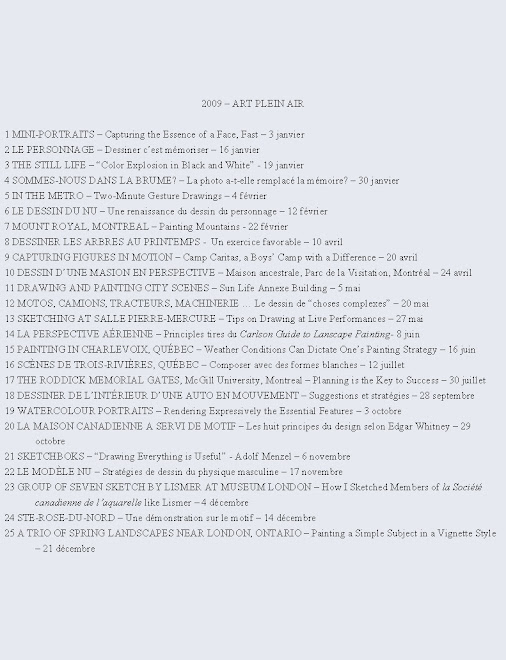
DESSINER DE L’INTÉRIEUR D’UNE AUTO EN MOUVEMENT – Suggestions et stratégies


Un défi stimulant!

Que faire lorsqu’on est en auto et qu’on n’est pas le chauffeur? Dessiner, bien sûr! C’est ce que j’ai fait récemment lors d’un voyage Montréal – London, Ontario. L’autoroute 401 est belle, mais le paysage est ennuyant. Afin de me divertir et de m’exercer j’ai dessiné et peint les véhicules que nous suivions.


Stylo feutre et aquarelle

Je pratique ce genre de dessin pour le pur plaisir et non pour le résultat. Bien sûr mes traits ne sont pas très précis à cause du mouvement du véhicule. J’ignore cela. C’est le processus qui m’amuse par le processus. Je préfère dessiner en auto au stylo feutre plutôt qu’au crayon parce que la marque est plus visible et directe qu’au graphite. Le crayon feutre permanent me permet d’ajouter plus facilement de la couleur à l’aquarelle. Parfois je peins sans un dessin préalable.


Les roues d’abord

Une fois que j’ai ciblé le véhicule que je vais croquer je commence à dessiner les roues sur le pavé estimant la distance entre celles-ci. Sans tarder, j’esquisse la forme du véhicule qui nous précède avant que nous le perdions de vue. Si l’auto ou le camion n’est plus dans mon champ de vision, je compose et j’invente les éléments manquants.


L’illusion de la perspective

Aussitôt que je décide quel véhicule je veux dessiner, je place mon cahier à la verticale sur mes genoux. J’aligne mon stylo le long des barres blanches peintes sur le pavé et je transfère ces obliques sur ma feuille. Elles convergent au niveau des yeux. J’observe avec intensité le paysage qui passe et j’invente « le mien » d’après ces images furtives. L’imprévisible fait parti de ce jeu. Je place des marques intuitivement et automatiquement selon les stimuli.


L’évolution du dessin

Il ne faut pas tenter de figer une scène imaginaire toute composée d’après les éléments vus et d’essayer de la reproduire de mémoire. Le plaisir et le défi de l’exercice est plutôt de partager son attention autant sur la route et le paysage que sur sa feuille. Donc, la faute serait de baisser la tête à un moment, d’ignorer ce qui se passe devant soi et de terminer le dessin de mémoire. Ceci serait aller contre le but visé qui est de composer et d’ajuster la composition selon les éléments aperçus le long du trajet. L’œuvre est toujours en évolution jusqu’à ce je décide d’en commencer une autre.


Processus plutôt que produit

C’est certain que si vous tentez cet exercice, les premières vous sembleront frustrantes. L’inconfort de balancer son carnet sur les genoux et le mouvement non seulement du véhicule mais du sujet vous sembleront peut-être insurmontables. Persistez! Tentez d’entrer dans une « bulle de processus » et non de produit. Ne vous attardez pas sur la précision. Observez et intégrez ce qui se passe dans votre vision. Essayer de comprendre la structure des véhicules et du paysage passant. Et surtout, n’effacer et ne rayez rien!


Bonne route!

Raynald Murphy sca

jeudi 30 juillet 2009

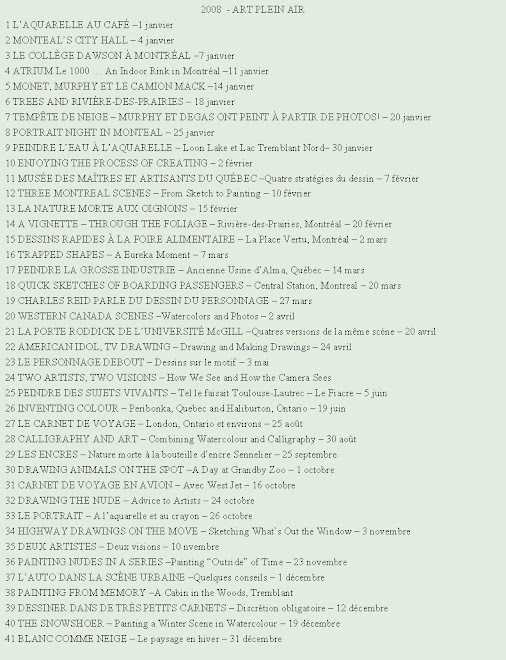
THE RODDICK MEMORIAL GATES, McGill University, Montreal – Planning is the Key to Success

The time you think you need versus the time you actually need.

A favorite painting subject, the Gates at the entrance to McGill University, was painted in thirty minutes. “Most people do not paint to deadlines, unless working on a commission. The natural inclination is to take all the time you have at your disposal, and there may appear to be no reason not to. But the time you think you need, compared to the time you actually need, may be quite different.” Gerald Green in The Artist magazine, May 2009.

Sketching in ink immediately

Sometimes fast is better and this was the case as no sooner had I sketched in the figures in ink standing in front of the gates that the students left and returned just as I was finishing the painting. The advantage of sketching the bones of a scene in ink is that the permanency of ink influences one to simplify and draw precisely. With a brush and pan watercolors I loosely added colored shapes using the line drawing as a guide.

How I approach “field work”

I feel it is important before starting to know clearly what one intends to do. Some questions I ask myself are: How long do I intend to paint the scene? Will I be disturbed where I stand or sit? What format should I use? What should I draw first? Should I paint a vignette or fill the whole page? Where is the light source? And finally, what attracted me to paint or sketch the scene?

I design mentally

For many years I drew preparatory “thumbnail” sketches. Now, I prefer to design mentally especially when painting a scene including the people or vehicles which can move away. Spending too much time on a preliminary small sketch might mean loosing precious time. There is no right or wrong way to plan before starting a painting. However, it is important to have a “plan” whether mental or on paper and to stick to it. In other words, be confident, have faith in your idea throughout.

Directing the viewer into the picture

It is important to lead the viewer into the scene. The two white lines painted on the pavement at bottom left point to the people walking towards us. They in turn direct us towards the group of blue figures. The horizontal beam of the gate at right directs us to the cluster of balloons which send us back to the figures. The base of the clock tower is at the center of interest. Finally, the posts at left prevent us from “walking” off the scene.


Suggest, don’t say everything

It is important to be selective and leave room for the viewer to interpret. Here, subtle contour lines of heads and spots of light suggest the interaction of students. The unpainted whites in and around the blue shirts suggest arm and hand position. The yellow spots of paint at right suggest objects or food on the table. I have hinted at architectural details here and there. Finally, the foliage is represented by loosely placed dabs of green, blue and yellow paint.


Strategically plan your whites from the start

Watercolorists know that it is very important to “plan” whites. If the whites are mistakenly painted over it is very difficult to go back and retrieve them. I made sure I carefully painted negatively around the white shapes – the tents, one side of the clock tower, the lamp post, the white street signs, the lines on the pavement, and the whites around the people.


Like athletes, artists should visualize

The next time you see a group of people standing around interacting why not draw them quickly before they disperse. If you mentally visualize the key elements before starting then you are planning for success. Athletes visualize before performing. Artists should do likewise.

Raynald Murphy sca