
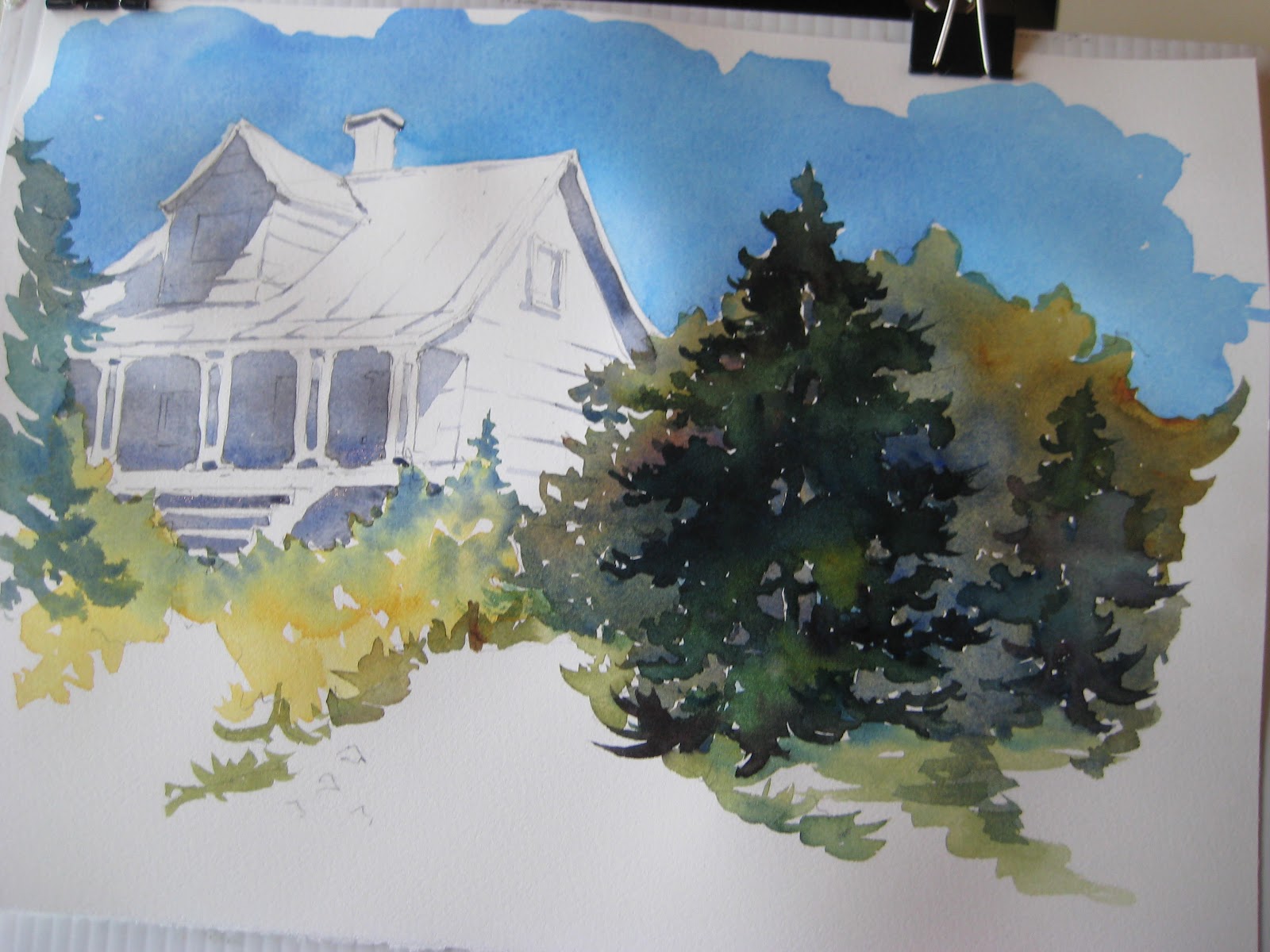
Stage 1: The high contrast of the white house positioned against a deep blue sky enticed me to sketch this scene. In order to do a studio painting from the gouache sketch, the extreme white tone of Strathmore Aquarius II paper seemed the correct choice. Moreover, I opted to use a variety of pigments which are not usually standards in my palette both for a different feel and to practice my color mixes. I used: Nickel Quinachridone Gold (M.Graham), Madder red dark ( Schmincke), Permanent red, Ultramarine deep. Peacock blue, Prussian blue and Lamp black (Holbein).

Stage 2: This polyester fiber paper lies flat
and should not be fixed to a board with masking tape because upon removal it
will tear its fibers when removed. I therefore fixed it to a board simply with metal
clips. I began by painting the sky wet on dry with a mixture of Peacock blue
and Ultramarine leaving an undulating uneven edge to the left, top and right.
In order to create an even sky I tipped the board back and forth horizontally immediately
after painting the blue in order to let the paint dry flat and evenly.

Stage 3: I painted wet on dry a small tree and bush shape
below the steps using Quinacridone gold. I dropped in some peacock blue into
this at the top edge. I also left some of the white paper unpainted to simulate
white reflections. I resisted the temptation to go back into this section once
painted otherwise the textured look would be lost. Notice that a carefully
designed tree shape overlaps the right side of the house.

Stage 4: Using an alternate mixture of Peacock
and Ultramarine blue and yellow with a hint of Madder red, I painted the
background tree shapes. In its interior I left unpainted a white pine tree shape
to be added later. I also added a tree
shape at the left of the house as a visual block to send the eye back into the
picture. This was let to dry.

Stage 5: Next, I carefully painted the dark
foreground pine tree shapes using Prussian blue, some Madder red dark and Ultramarine
with a touch of yellow.

Stage 6: The colorful greys of the shadow areas of the house
were added at this point. I used a mixture of Ultramarine, Madder red and a
hint of black to achieve a luminous grey tone.
Stage 7: It was important for me to resist
painting with Permanent red the trim of the house until now. Otherwise I would
have risked the red bleeding into the adjacent colors. Next, I added the shadow
shapes on the path leading to the house with Ultramarine, Madder red and some
black. The nearer brown rocks were outlined using the right mix of red, yellow
and blue. Finally, with a mix of Ultramarine and Lamp black I painted very
carefully the many window shapes around and between the white roof posts. Deep
black was used under the balcony. After
adding deeper tones to the left of the foreground rocks, I titled it: Rapide-Danseur’s White House which was
originally the Rectory of the church in Rapide-Danseur, a small town just south
of La Sarre in Abitibi-Témiscamaingue, a region north west of Montréal.
Raynald Murphy sca



 Articles

